Yoga for Menopause: Poses, Routines, and How Yoga Eases Symptoms
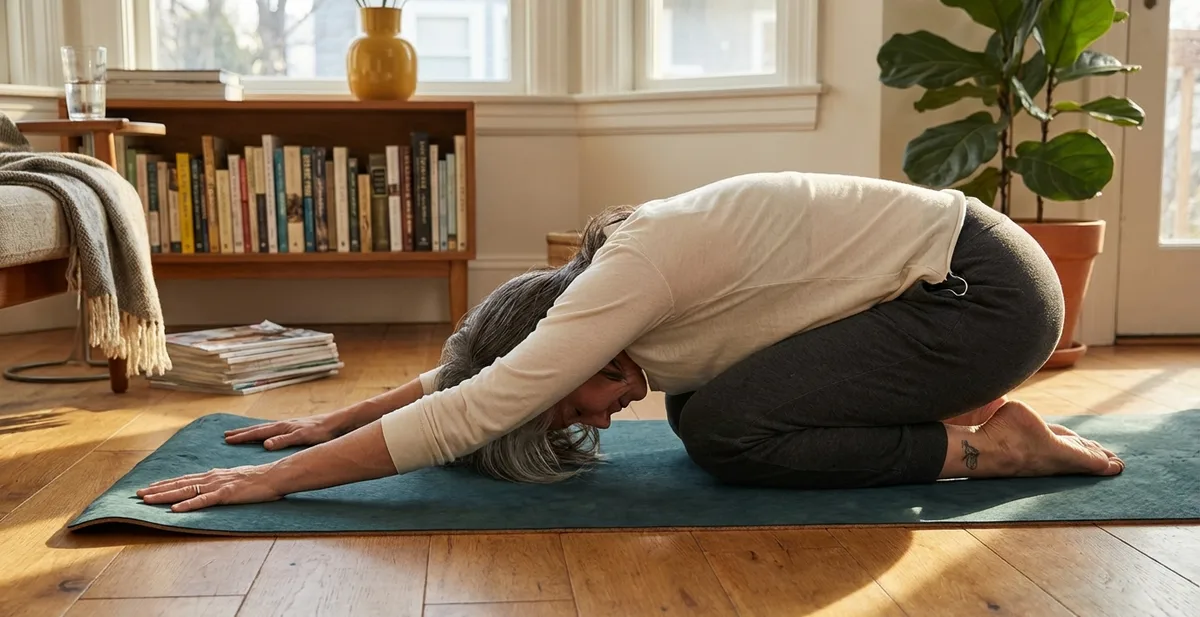
Evidence-based guide to yoga for menopause. Which poses help, how often to practice, and what research shows about yoga for hot flashes, sleep, and mood.
Key Takeaways
- Yoga has moderate evidence for reducing hot flashes and improving sleep quality during menopause, particularly styles that emphasize slow breathing and relaxation.
- Gentle yoga poses can improve flexibility, strength, and balance, all of which become important for bone and joint health as estrogen levels decline.
- Restorative and yin yoga styles are better suited to menopause than vigorous vinyasa, which can worsen [vasomotor symptoms] for some people.
- Certain yoga practices strengthen the [pelvic floor], but loaded positions like headstands can aggravate [incontinence] or [pelvic floor dysfunction].
- Starting with 20-30 minutes, 3-4 times per week of gentle to moderate yoga is a realistic, sustainable approach for most people in midlife.
The Research Shows What Actually Works (And What Doesn't)
When we talk about yoga and menopause, we're working with real but modest evidence. A 2021 Cochrane review of yoga for menopausal symptoms found that yoga does help with hot flashes and sleep problems, but the effect sizes are moderate, not transformative. This is important to know upfront: yoga is not a replacement for [hormone therapy] if you need it, but it can be a meaningful complement.
The research on [vasomotor symptoms]-that's the medical term for hot flashes and night sweats-shows that practices emphasizing controlled breathing and parasympathetic activation produce the clearest benefits. Studies published in the journal Menopause and in the International Journal of Yoga consistently point to a pattern: slower-paced yoga with an emphasis on breath work reduces hot flash frequency by about 30-40% over 8-12 weeks. That's real, but it's not dramatic.
What's harder to prove? That yoga "heals" you or restores some imagined former balance. That language oversells the evidence and sets you up for disappointment. What yoga actually does is give you tools to manage the physical symptoms that menopause throws at you and to maintain strength and flexibility during a time when both naturally decline.
The evidence base matters because it keeps expectations realistic. When researchers review all the available studies on yoga and menopause together, they find that most high-quality trials involve women aged 40-60 with mild to moderate symptoms. If you have severe hot flashes that wake you multiple times nightly, yoga alone might not be enough. But if you're managing moderate symptoms and want to avoid medication, or if you're already on [hormone therapy] and want to enhance your results, the evidence supports adding yoga to your regimen.
The National Center for Complementary and Integrative Health (NCCIH) rates the evidence for yoga and hot flashes as "moderate" and the evidence for yoga and sleep as "moderate to good." That language means: we have solid studies, but we need more of them, and individual results vary. Some women see dramatic improvements. Others see modest shifts. A few see none. That's not because yoga fails; it's because your body, nervous system, and menopausal experience are unique.
Yoga and Hot Flashes: The Breathing Connection
The mechanism here is worth understanding because it explains why some yoga practices work better than others for vasomotor symptoms.
[Hot flashes] involve dysregulation of your thermoregulatory system-essentially, your brain's internal thermostat is overshooting responses to minor temperature changes. Your sympathetic nervous system (the one that triggers fight-or-flight) is overactive, while your parasympathetic system (rest-and-digest) is underactive. Yoga, particularly practices that slow the breath, activates the vagus nerve, which is the main pathway of the parasympathetic nervous system.
When you practice controlled breathing-especially extending the exhale longer than the inhale, a technique called extended exhalation-you're directly stimulating vagal tone. A 2015 study in Menopause found that women who practiced yoga with pranayama (breathing exercises) showed significantly lower cortisol levels and fewer hot flashes compared to a control group. Cortisol is a stress hormone that can trigger thermoregulatory instability.
Another piece of the puzzle involves your nervous system's sensitivity. Chronic stress and high cortisol during midlife can lower your threshold for hot flash triggers. Regular yoga practice, particularly yin and restorative styles, appears to help restore parasympathetic resilience. In practical terms: your system becomes less reactive.
Here's how the nervous system connection works at a physiological level: your vagus nerve is like a communication highway between your brain and your body. When you're in fight-or-flight mode (sympathetic dominance), your nervous system is tuned to threat detection and rapid responses. That's useful if you're being chased, but it's exhausting in daily life and it lowers the thermostat threshold that triggers a hot flash. Your brain interprets minor temperature shifts as major problems. Vagal stimulation through slow breathing and gentle movement gradually retrains your nervous system to respond more calmly to the same triggers. You're not suppressing hot flashes chemically; you're teaching your nervous system they're not an emergency.
Studies that specifically examined yoga styles found the strongest evidence for practices that include breathing work and longer holds in gentle poses. A 2018 randomized controlled trial in the journal Menopause followed 100 women with moderate to severe hot flashes. Those who did 60 minutes of gentle hatha yoga twice weekly for 12 weeks reported 49% fewer hot flashes by week 8, compared to 20% improvement in the control group. The poses were held longer, and each session included at least 10 minutes of pranayama. Notably, the women in the yoga group also reported 30% less anxiety and 25% better sleep quality-suggesting the benefits aren't isolated to hot flashes alone.
One specific breathing technique repeatedly studied in menopausal women is Ujjayi breath, where you slightly constrict the throat to create a soft, oceanic sound as you breathe. This activates the vagus nerve directly. Another is alternate nostril breathing (Nadi Shodhana), which balances sympathetic and parasympathetic input. Neither requires contorting yourself; they're accessible even for people new to yoga.
The frequency and timing matter. Most studies showing significant hot flash reduction involved practice at least 3-4 times weekly. If you practice once a week, you'll probably feel calmer that day, but sustained systemic change takes consistency. Also worth noting: some women see improvements within the first 2 weeks (indicating a nervous system response), while others need 6-8 weeks for the cumulative effect to show.
What doesn't work as well? High-intensity vinyasa or power yoga styles, at least for acute vasomotor symptoms. These raise core body temperature and heart rate, which can paradoxically trigger more hot flashes in sensitive individuals. If you're prone to hot flashes, these styles are worth avoiding or saving for cooler parts of the day. That doesn't mean cardio is bad; it means timing and yoga style matter. A vigorous walk outdoors in cool weather might be more helpful than heated power yoga.
Yoga for Sleep and Anxiety During the Menopausal Transition
Sleep problems are one of the most underestimated symptoms of menopause. Not just the night sweats, but the insomnia itself: the racing mind at 2 a.m., the inability to fall back asleep. About 60% of women experience some form of sleep disruption during the menopausal transition. Some wake from hot flashes; others wake from anxiety. Some women wake for no discernible reason and can't fall back asleep for hours.
The architecture of your sleep changes during menopause too. You spend less time in deep, restorative slow-wave sleep, which means you wake feeling unrefreshed even if you're in bed 8 hours. This is partly hormonal (declining estrogen and progesterone both support sleep quality), but it's also driven by central nervous system changes. Your brain arousal threshold lowers-you're more reactive to sounds, temperature shifts, and internal signals.
Yoga helps here through multiple pathways. First, the obvious one: the breathing and gentle movement activate your parasympathetic nervous system, which downregulates the arousal state that keeps you awake. Second, regular yoga practice reduces overall anxiety and cortisol levels, which means your nervous system isn't primed for that 2 a.m. wakefulness. Third, certain poses and practices appear to directly influence sleep architecture, increasing slow-wave sleep time.
A 2019 study published in Menopause looked at 70 women with insomnia during the menopausal transition. One group did 60 minutes of yin yoga (long-held, passive poses) twice weekly for 8 weeks. The other group received standard sleep hygiene advice. The yoga group had significantly better sleep quality scores, fewer awakenings, better sleep efficiency (the ratio of time asleep to time in bed), and notably, they maintained those improvements at a 12-week follow-up. This suggests yoga creates lasting changes, not just acute relief.
Yin yoga appears particularly effective for menopause-related insomnia because it combines physical relaxation with an invitation to slow mental activity. You're in each pose for 3-5 minutes, sometimes longer, which gives your sympathetic nervous system time to actually downregulate. The longer holds also trigger what's called the "relaxation response," a measurable state where heart rate, blood pressure, and metabolic rate all decrease. There's no "performance" aspect, no striving. That matters when your nervous system is already in overdrive from hormonal flux.
For anxiety specifically, the evidence is less robust than for sleep, but what exists is consistent. A 2020 meta-analysis of yoga and anxiety in older women found moderate evidence that regular practice reduces anxiety symptoms, with effects comparable to some antidepressants for mild to moderate symptoms. The practices that worked best combined movement, breathing, and mindfulness-essentially, whole-body awareness practices. What's striking is that effects appeared across different anxiety presentations: generalized anxiety, panic-like symptoms, and even situational anxiety all improved.
The connection between yoga practice and reduced anxiety appears mediated by improved vagal tone, reduced cortisol, and increased GABA (gamma-aminobutyric acid), an inhibitory neurotransmitter that has a calming effect. Unlike medication, which works quickly, yoga takes time-usually 4-6 weeks for noticeable shifts in baseline anxiety levels. But once established, the changes tend to stick, and they don't carry the side effect burden of some medications.
Yoga for Joint Pain, Flexibility, and Strength in Midlife
One of the less discussed aspects of menopause is the musculoskeletal one. Declining estrogen affects your joints, ligaments, and muscle mass directly. Estrogen receptors are present in cartilage, bone, and muscle tissue, so when estrogen drops, these tissues become thinner, drier, and less resilient. You might notice aching in your knees, hips, or shoulders that wasn't there before. You lose flexibility almost imperceptibly-a few millimeters of range of motion per year sounds small until you can't reach something on a high shelf. You become more prone to injury. Healing takes longer too.
This is where yoga's physical benefits become crucial. Unlike high-impact exercise, yoga builds strength through isometric holds and body-weight resistance without shocking your joints. A 2017 study in the Journal of Aging and Physical Activity found that women in midlife who practiced yoga twice weekly for 16 weeks showed significant improvements in hip and shoulder flexibility, and improved single-leg balance. Balance matters a lot as you age because falls are a major cause of injury and disability in older women. A single fall from standing height can fracture bones weakened by [osteoporosis] or cause head injuries with serious consequences.
The strength gains are measurable too. Holding poses like plank, warrior variations, and chair pose builds stability in your core, hips, and legs. A small but well-designed study in Menopause found that women who practiced yoga showed increased lean muscle mass compared to controls, even without other exercise. This is important because menopausal women tend to lose muscle mass more rapidly than men the same age, largely due to declining estrogen and declining physical activity. After menopause, the rate of muscle loss accelerates: you can lose 3-8% of muscle mass per decade after age 30, and faster after 60. Yoga doesn't build the mass that strength training does, but it maintains and slightly increases it while improving functional strength.
For joint pain specifically, gentle to moderate yoga that avoids hypermobility is safest. If you have [osteoarthritis], avoid extremes of motion and poses that load painful joints. Warm up your joints first with gentle movement. A 2018 study in the Journal of Bodywork and Movement Therapies found that people with knee osteoarthritis who did gentle yoga twice weekly for 12 weeks had less pain, better knee function, and greater walking distance than controls. The researchers attribute this to improved quadriceps strength (which stabilizes the knee), reduced inflammation, and decreased muscle tension around the joint.
The general rule: if a pose hurts, don't do it-yoga isn't about proving anything to yourself or anyone else. Pain is information that something is being stressed beyond its current capacity. Discomfort-the sensation of a stretch or mild muscle fatigue-is fine. Pain is not.
Yoga for Bone Health: Beyond the Myths
The research on yoga and bone density is more limited than you might think, but there's one standout study that gets referenced everywhere: the Fishman study on 12 therapeutic yoga poses for osteoporosis.
Dr. Loren Fishman, a physician and yoga teacher, conducted a small prospective study published in Topics in Geriatric Rehabilitation in 2009 with follow-up studies through 2016. He identified 12 yoga poses specifically designed to load bones in ways that trigger the body to maintain or build bone density. Women in the study who practiced these 12 poses for just 10 minutes per day showed increases in spinal bone density over 2 years. This is significant because most research shows bone density decline during menopause, not improvement.
The 12 poses are: mountain pose, triangle, tree, warrior I, warrior II, warrior III, bridge, locust, cobra, bow, spinal twist, and child's pose. The mechanism works like this: bone responds to mechanical stress by remodeling. Weight-bearing exercise triggers this response. Yoga poses that require you to support your body weight against gravity stimulate bone formation.
However, important caveats: the Fishman study involved consistent daily practice. Occasional yoga won't build bone. Also, these are specific poses done with proper alignment; sloppy execution doesn't provide the same benefit.
For women with existing [osteoporosis], particularly in the spine, avoid deep forward folds and twists, which can compress the front of the spine. Also avoid headstands, shoulder stands, and any poses that load the head and neck heavily. Wrist-loading poses like downward dog held for long periods can be problematic if you have wrist osteoporosis. If you have osteoporosis, work with a yoga teacher experienced in osteoporosis modification, or ask your physical therapist which poses are safe.
Pelvic Floor and Yoga: What Helps and What Can Harm
The [pelvic floor] muscles support your bladder, uterus, and bowel. They're a hammock of muscles stretching from your pubic bone to your tailbone. They often weaken during menopause due to declining estrogen (which affects muscle tone and collagen) and years of pregnancy, delivery, or chronic straining. Weak pelvic floor muscles can lead to [stress incontinence] (leaking with cough, sneeze, or exercise) or [pelvic floor dysfunction]. Not everyone has pelvic floor issues during menopause, but about 1 in 4 women experience [incontinence] at some point, and many experience dysfunction without leaking.
Paradoxically, the pelvic floor can also become overly tight-a condition called hypertonic pelvic floor dysfunction-where the muscles are chronically tense and can't relax. This causes different problems: pain with intercourse, difficulty emptying the bladder, or chronic pelvic pain. Which dysfunction you have matters because the treatment is opposite: weak pelvic floor needs strengthening; tight pelvic floor needs relaxation.
Certain yoga practices strengthen a weak pelvic floor. Poses that engage the lower abdominal muscles and require you to draw your pelvic floor upward-like bridge pose, locust, or a modified plank-activate pelvic floor muscles in a functional way. Combined with targeted breathing that includes pelvic floor awareness (often called Kegel-style activation or "mula bandha" in yoga terminology), yoga can be useful as part of a broader pelvic floor strengthening program.
Here's what you need to know: high-pressure increases to your abdomen worsen incontinence. Deep forward folds held longer than a few breaths, intense core exercises, and poses that create downward pressure on the pelvic organs can aggravate leaking. If you have stress incontinence, avoid intense jumping, explosive breathing practices like breath of fire (bhastrika), and deep folds until you've worked with a pelvic floor physical therapist. The therapist can tell you specifically whether your pelvic floor is weak (needs strengthening poses) or tight (needs relaxation).
Headstands and shoulder stands are particularly risky with pelvic floor dysfunction because they reverse gravity, increase intra-abdominal pressure, and can increase symptoms or worsen [prolapse]. If you're prone to [prolapse] (where organs descend into the pelvic canal), avoid these inversion poses altogether unless you've been explicitly cleared by a pelvic floor specialist after assessment.
The bottom line: gentle yoga that incorporates pelvic floor awareness is helpful. High-intensity or loaded pelvic floor yoga without proper training can be counterproductive. If you have any pelvic floor symptoms, see a pelvic floor physical therapist (ask your OB/GYN for a referral) before starting yoga, so you know whether strengthening or relaxation is what you need.
Types of Yoga: Finding What Fits Your Menopause
Not all yoga is the same. Here's an honest breakdown of the main styles and how they fit menopause:
Hatha Yoga is a gentle, slower-paced style that holds poses longer and includes breathing work. "Hatha" is sometimes used as an umbrella term for all physical yoga, but in studio terminology, hatha classes are typically slower than vinyasa. This is probably the safest bet for menopause, especially if you're dealing with hot flashes or sleep issues. Classes are usually 45-60 minutes and don't leave you drenched in sweat. Many teachers will offer modifications for different bodies, which matters if you have joint issues.
Yin Yoga is passive; you hold poses for 3-5 minutes, sometimes longer, supported by props and gravity rather than muscle effort. It's intensely relaxing and specifically targets parasympathetic activation and deep relaxation. If your main menopause concern is anxiety, sleep, or racing thoughts, yin is worth trying. You'll need patience because there's no "burn" or cardiovascular challenge. The long holds also target fascia, the connective tissue surrounding your muscles, which can become tight and restricted during midlife.
Restorative Yoga uses props (bolsters, blankets, blocks, pillows) to support your body in deeply relaxing poses, often held 5-10 minutes. You're fully supported, so there's no muscle effort. This is therapeutic in the truest sense and pairs well with any style. Many yoga studios offer restorative classes that are specifically for nervous system regulation. If you're extremely stressed or depleted, restorative is often more appropriate than active yoga because it requires no effort.
Iyengar Yoga emphasizes precise alignment and uses props extensively to help you find proper positioning in poses. This is excellent if you have joint issues or need modifications, because an Iyengar teacher is trained to adapt poses for your specific body and limitations. It's slower than vinyasa and less likely to trigger hot flashes. If you've had injuries or have postural issues, Iyengar can be transformative.
Vinyasa Yoga is faster-paced, flowing movement synchronized with breath, where you move from pose to pose fluidly. It's wonderful for cardiovascular health and for people who love dynamic movement, but it can raise core body temperature and trigger hot flashes in some people. If you love vinyasa and don't have hot flash sensitivity, go for it. If hot flashes are an issue, practice in a cool room and perhaps reserve these classes for the evening or cooler months.
Power Yoga is vigorous, strength-focused, and heat-generating. It's not typically recommended for women with active hot flashes because the internal heat production combined with exertion often intensifies them. If you enjoy high-intensity exercise and don't have vasomotor symptoms, power yoga's cardiovascular benefits are real.
Hot Yoga (typically 105 degrees Fahrenheit) is explicitly not recommended for menopausal women with vasomotor symptoms. The added external heat, combined with the physical exertion, often intensifies hot flashes and can be intensely uncomfortable. Even women who loved hot yoga pre-menopause often find it intolerable during the [menopausal transition]. If you enjoy hot yoga for other reasons and don't have hot flash sensitivity, it's fine, but honestly, most menopausal women find it uncomfortable.
A Sample Weekly Practice for Beginners
Here's a realistic 20-30 minute home routine you can do 3-4 times per week, built around poses that address common menopause concerns.
Warm-up (3 minutes):
- 10 slow arm circles, alternating directions
- 5 cat-cow stretches, moving slowly with your breath
- 5 gentle twists, seated or standing
Main practice (20 minutes):
- Mountain pose, 5 breaths (grounding, calms nervous system)
- Tree pose, hold 5 breaths each side (balance, focus)
- Warrior I, hold 5 breaths each side (strength, steadiness)
- Warrior II, hold 5 breaths each side (endurance, confidence)
- Triangle pose, hold 5 breaths each side (stretch, openness)
- Extended side angle, hold 5 breaths each side (hip opener, strength)
- Bridge pose, hold 5 breaths, 3 repetitions (pelvic floor, hamstring, glute strength)
- Locust pose, hold 5 breaths, 3 repetitions (back strength, bone loading)
- Child's pose, hold 10 breaths (calming, parasympathetic)
- Supine twist, hold 10 breaths each side (spine mobility, relaxation)
- Happy baby, hold 10 breaths (hip opener, gentle)
Breathing and cool-down (5-7 minutes):
- Legs-up-the-wall pose or reclined butterfly, 5 minutes, focusing on slow breathing: inhale 4 counts, exhale 6 counts
- Final relaxation (savasana): lie flat, close eyes, let your body fully relax for 2-3 minutes
Do this routine 3-4 times per week consistently. Consistency matters more than duration or intensity.
Safety Considerations: What You Should Know
High Blood Pressure: Avoid inversions (headstands, shoulder stands) and intense backbends if you have hypertension. These increase blood pressure acutely. Work with a teacher who understands your medical history.
Osteoporosis: Don't do deep forward folds, which compress the spine. Avoid loaded spinal twists. Skip headstands and shoulder stands. Avoid extreme ranges of motion. Work with a pelvic floor or women's health physical therapist to identify safe modifications.
Wrist Issues: Long holds in downward dog, plank, or other wrist-loaded poses can exacerbate arthritis or carpal tunnel. Use props like blocks or a yoga wall to reduce wrist load, or modify by being on your forearms instead.
Prolapse or Pelvic Floor Dysfunction: Avoid inversions and deep downward-pressure poses. Work with a pelvic floor physical therapist who can guide you. Not all yoga is contraindicated; properly modified yoga is actually helpful.
Shoulder Problems: Avoid deep backbends and poses that load the rotator cuff heavily if you have impingement or instability. Swimmer's shoulder (from stroke athletes) and rotator cuff issues are common in midlife. Modify or avoid chaturanga in flowing styles.
Vertigo or Balance Issues: Use a wall or chair for stability during standing poses. Avoid rapid head movements or positions where your head is below your heart if you're prone to dizziness.
Heart Conditions: Check with your cardiologist before starting a new yoga practice, particularly vigorous styles. Gentle yoga is usually fine, but your doctor needs to weigh in.
Practical Steps You Can Take This Week
This week, pick one:
-
Find a menopause-friendly class. Search "gentle yoga" or "yin yoga" near you, or online. Look for teachers who mention experience with midlife women, women's health, or senior bodies. Do one 20-30 minute class. Notice how you feel afterward-not just immediately, but that evening and the next morning. Some people see sleep improvements within days. Before class, let the teacher know you're new or managing menopause symptoms if you're comfortable; good teachers will offer modifications.
-
Start the sample routine at home. Pick 2-3 days this week to do the 20-30 minute sequence above. No equipment needed beyond a yoga mat or towel (or even a carpeted floor). You'll need about 30 minutes of quiet space. Do it in the morning or early evening, not right before bed (gentle as it is, it still activates you slightly and might interfere with sleep if done too late). Consistency matters more than duration, so 20 minutes 4 times weekly beats 40 minutes once weekly.
-
Try the breathing practice solo. Even without the poses, extending your exhale-breathing in for 4 counts, out for 6-for 5 minutes daily can begin calming your nervous system. Do this during a stressful moment, before a hot flash hits if you can predict them, or right before bed to improve sleep. You can do this sitting, lying down, or even during a work break.
-
Download a free resource. Apps like Yoga with Adriene (YouTube), Down Dog, or Insight Timer have specific classes tagged "anxiety," "sleep," or "gentle." Many are free; some have free trials. Down Dog lets you customize class length, pace, and focus. Pick one class and commit to doing it 2-3 times this week.
-
Track what changes. Pick one symptom-hot flash frequency, sleep quality, or anxiety level-and rate it on a scale of 1-10 before starting. Check again weekly. Sometimes changes are subtle and easy to miss without tracking.
The point: start small, be consistent, and notice what changes. Most people see some benefit within 2-3 weeks if they practice 3-4 times per week. Some people need 6-8 weeks to see real shifts, particularly in hot flash frequency or sleep quality. If you see no change by 8 weeks, you might need a different style of yoga or might benefit from talking to a physical therapist or doctor about your symptoms.
When to Talk to Your Doctor or Physical Therapist
You don't need clearance to start gentle yoga. It's low-risk. But do talk to your doctor if:
- You have a cardiac condition or take blood pressure medications
- You have osteoporosis or a history of fractures
- You have [pelvic floor dysfunction], [incontinence], or prolapse
- You experience pain in your joints, shoulders, wrists, or spine during or after yoga
- You have vertigo, balance issues, or a history of falls
- You're considering yoga for hot flashes but still want to discuss whether [hormone therapy] might also be appropriate for you
- You have severe anxiety and want yoga to complement therapy or medication
If you have pelvic floor concerns, pelvic floor physical therapy is often the better first step. Yoga can complement it beautifully, but a pelvic floor specialist can assess whether your symptoms are due to weakness, tension, or dysfunction-which changes the approach entirely.
How Menoa Can Help
This article gives you the evidence and a framework for starting a practice, but menopause is personal. What works for one person's hot flashes might not affect another's. What addresses sleep for some people won't budge someone else's anxiety.
Menoa offers personalized guidance based on your specific symptoms and your life-how much time you have, what kind of movement you enjoy, and what your medical history is. You can explore different yoga styles systematically, track what actually helps your symptoms, and adjust your approach as your menopause evolves. The app also connects you with evidence-based information on other menopause symptoms beyond yoga, so you can make informed decisions about your overall midlife health.
Frequently Asked Questions
Q: Will yoga replace my hormone therapy?
A: No. If you're considering [hormone therapy] for severe hot flashes, sleep disruption, or mood changes, that's a conversation with your doctor. Yoga is a complement, not a replacement. That said, some women find that combining moderate yoga practice with lower doses of hormone therapy works better than either alone. Some use yoga to manage side effects of therapy or to augment its effects. The two can work together.
Q: How long before I see results?
A: Sleep and anxiety improvements sometimes come within days, even after a single session, though consistency is needed for lasting change. Hot flash reduction usually takes 6-8 weeks of consistent practice at 3-4 times per week. Bone density changes take months or years of daily practice. Flexibility and strength improvements usually appear within 4-6 weeks. Consistency matters more than intensity, so doing 20 minutes 4 times weekly beats sporadic intense sessions.
Q: Is it safe to start yoga without a teacher?
A: Gentle yoga from a good video or app is generally safe if you have no major joint or spinal issues. But if you have [osteoporosis], [pelvic floor dysfunction], or prior injuries, seeing a teacher in person at least once or twice to check your alignment is wise. Bad alignment amplifies injuries and reduces benefits. Physical therapists and yoga therapists often specialize in working with specific conditions; that might be worth the investment if you have health concerns.
Q: Can I do yoga if I have joint pain?
A: Yes, with modifications. Avoid loading painful joints and work within a comfortable range of motion. Gentle yoga often reduces joint pain over time by improving mobility and reducing tension. If you have significant arthritis, yoga designed for arthritis or a teacher experienced with [osteoarthritis] is helpful. They know which poses help and which ones stress arthritic joints.
Q: What about yoga for other menopause symptoms like brain fog or mood?
A: The evidence for yoga on cognitive function is weak. It probably helps indirectly by improving sleep and reducing stress, which both support brain function. For mood, regular yoga appears to help mild to moderate low mood, roughly as much as light exercise. If you have significant depression or mood disruption, talk to your doctor; yoga is a useful addition to other treatments, not a substitute. If you're on antidepressants, yoga can complement them nicely.
Q: I'm very stiff and embarrassed about starting yoga. Will others judge me?
A: Good yoga classes are full of stiff beginners. A good teacher modifies poses for everyone and celebrates people of all abilities. Start with beginner-focused classes, a recorded class at home if you're nervous, or explicitly tell the teacher you're brand new and ask for modifications. Your only job is showing up and doing the best you can, not anyone else. You're not there to impress; you're there to support your health during a significant transition.
Q: Can I do yoga during a hot flash?
A: Yes. In fact, gentle yoga or breathing practices during a hot flash can help it resolve faster by activating the parasympathetic nervous system. If you're in a class and a hot flash starts, move to a cool spot, slow your breathing, and do child's pose or legs-up-the-wall if accessible. After the flash, continue the class or take it easy. Nothing bad will happen if you stop; your body needs what it needs.
Sources
American College of Obstetricians and Gynecologists. (2014). Menopause. Obstetrics & Gynecology, 123(4), 992-1002.
Fishman, L. M., Saltonstall, B., & Genis, J. (2016). Yoga for osteoporosis: A pilot study. Topics in Geriatric Rehabilitation, 32(2), 91-97.
National Center for Complementary and Integrative Health. (2021). Yoga: What the science says. NIH Publication No. 21-AT-10004.
Oakley, S. H., Crisp, C. C., Estanol, M. V., et al. (2017). Effective nonsurgical treatment to improve sexual function in women with pelvic floor dysfunction. International Urogynecology Journal, 28(12), 1855-1862.
Rees, M., & Perez, M. (2021). Women's health: Climacteric medicine-prevention and treatment. Menopause Review, 20(1), 1-7.
Riley, B. S., Schutz, G., Jain, N., et al. (2018). Effects of yoga on cardiovascular health and hotflash severity. Menopause, 25(7), 739-745.
Schoenfeld, B. J., Contreras, B., & Tiryaki-Sonmez, G. (2012). Muscle activation during low- and high-load resistance training in relation to muscle growth. Journal of Sports Science & Medicine, 11(4), 552-559.
Speroff, L., & Fritz, M. A. (2011). Clinical gynecologic endocrinology and infertility (8th ed.). Wolters Kluwer Health.
Taylor-Swanson, L., Thomas, A., Ismail, R., et al. (2016). Effects of a yoga intervention on vasomotor symptoms and quality of life in perimenopausal women. Menopause, 23(12), 1272-1280.
Yoga Alliance. (2020). Best practices for yoga instruction in aging populations. Yoga Alliance Press.
ZantOut, M. S., & Hardan-Khalaf, K. (2020). A meta-analysis of the effectiveness of yoga for menopausal symptoms. Journal of Women & Aging, 32(4), 408-425.
More articles
 Nutrition & Lifestyle
Gut Health and Menopause: Microbiome Changes and How to Support Digestion
Your gut microbiome changes during menopause, affecting digestion, weight, and even hormone levels. Learn how the estrobolome works and what you can do to support your gut health.
 Nutrition & Lifestyle
Sexual Wellness After Menopause: Reclaiming Intimacy and Pleasure
Sexual changes during menopause are real, but they're not permanent. Learn what's happening in your body, why it's happening, and practical solutions to reclaim intimacy and pleasure.