Exercise for Menopause: A Complete Evidence-Based Guide
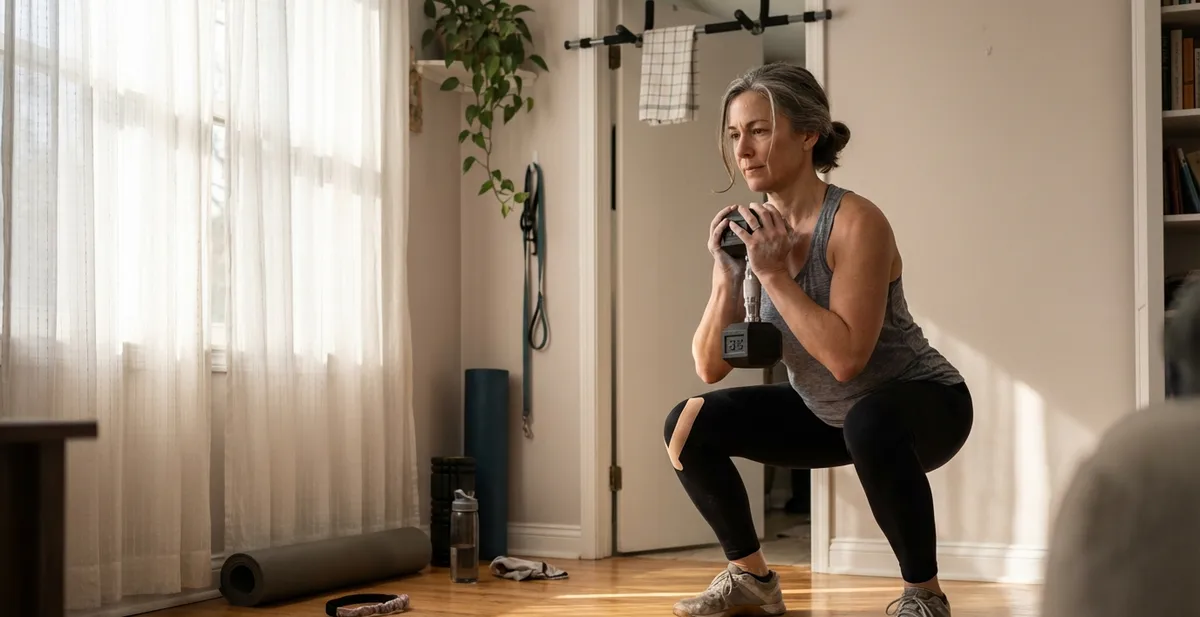
Science-backed exercise guide for menopause. Why strength training matters, how to protect bone, and what actually works for midlife bodies.
Key Takeaways
- Women lose up to 20% of bone mass in the first seven years after menopause, but resistance training 3 times weekly can halt and reverse this loss.
- Resistance training at 70-85% of your maximum strength, performed for at least 48 weeks, significantly improves bone density at the lumbar spine and femoral neck (meta-analysis of 17 RCTs).
- The SWAN study found that physical activity was the strongest predictor of grip and pinch strength during the menopause transition, independent of age.
- High-intensity interval training (HIIT) reduces abdominal fat and improves cardiovascular health, but keep intervals under 60 seconds to avoid excessive cortisol elevation during menopause.
- Start with two sessions of strength training plus 150 minutes of moderate aerobic activity weekly. This combination protects bone, preserves muscle, and improves weight management more effectively than cardio alone.
- Nearly 20% of women aged 40-55 report physical limitations, but 14-55% actually experience improvements in functioning during midlife through consistent exercise (SWAN data).
The Invisible Shift Happening in Your Body Right Now
You probably feel stronger than you did at 25. Maybe you can deadlift more, run faster, or carry groceries upstairs without thinking about it. Then something shifts. Not overnight. Around 40 or 45, you notice you're tired after climbing a flight of stairs. Your jeans fit differently even though the scale hasn't moved. Your knees ache after a run you used to love. This isn't weakness. It's not age. It's your hormones changing, and your body is literally recomposing itself whether you're paying attention or not.
What's happening is real. Menopause doesn't just bring hot flashes and irregular periods. It brings a fundamental change in how your body builds and maintains muscle, stores fat, protects bone, and responds to the exercise you've always done. The training plan that worked at 35 won't work at 50, and that's not a failure on your part.
The good news is equally real: the right exercise protocol during menopause and perimenopause isn't just damage control. It's the most powerful tool you have to feel strong, maintain independence, and protect your long-term health.
Why Exercise Changes at Midlife
Your body's exercise response changes because your hormones do. Estrogen doesn't just regulate your cycle. It affects how your muscles repair after training, how quickly your metabolism works, how your bones respond to load, and even how you recover from intense effort.
As estrogen declines during perimenopause and menopause, several things happen simultaneously. Your muscles become more resistant to growth, a condition called sarcopenia. You begin losing 3-8% of your muscle mass per decade after 30, and menopause accelerates this loss. Your bones become less responsive to exercise stimulus. And your body preferentially stores fat in your abdomen rather than your hips and thighs, increasing cardiovascular and metabolic risk.
Cortisol, your stress hormone, also behaves differently. During reproductive years, estrogen helps regulate cortisol responses. As estrogen drops, cortisol spikes more easily with intense exercise and takes longer to recover. This is why the 90-minute HIIT sessions that worked at 35 can actually make you feel worse at 50.
Your bone density faces particular pressure. In the first seven years after menopause, women can lose up to 20% of their bone mineral density. This isn't aesthetic. It directly increases fracture risk and the possibility of future disability. Weight-bearing and resistance exercise is one of the few interventions that can meaningfully slow, halt, or reverse this loss.
What the Evidence Actually Shows
The research on exercise and menopause is more robust than most people realize, and it consistently shows that the type, intensity, and frequency of exercise matter far more than total volume or flashy trends.
A meta-analysis of 17 randomized controlled trials involving 690 women found that resistance training produced meaningful changes in bone mineral density. At the lumbar spine, the effect size was 0.88. At the femoral neck (upper thighbone), the effect size was 0.89. These aren't marginal improvements. They represent clinically significant protection against fracture risk.
The SWAN study, which followed over 3,000 women from multiple racial and ethnic backgrounds through the menopause transition, found that physical activity was the strongest predictor of grip and pinch strength during midlife. Women with higher habitual physical activity maintained significantly better hand and finger strength as they transitioned through menopause, independent of age or menopausal status.
The same SWAN research found that women with greater leisure-time physical activity showed a slower decline in bone density at the femoral neck and maintained higher bone density overall at both the femoral neck and lumbar spine. Every half-standard-deviation increase in total activity was associated with a 1.6-point decrease in percent body fat among white women in the study, and similar patterns held across other racial and ethnic groups.
Cardio alone isn't the answer. Moderate-intensity aerobic exercise is important for cardiovascular health, but it provides minimal stimulus for bone and muscle maintenance. Resistance training is non-negotiable during menopause.
Strength Training: The Non-Negotiable
If you do one thing differently during menopause, it should be adding resistance training if you're not already doing it, or intensifying it if you are.
Resistance training works during menopause because it creates mechanical load on bones and muscles that signals your body to maintain and build, even as hormones are declining. This signal is powerful enough to overcome some of the catabolic effects of dropping estrogen.
The optimal parameters from the meta-analysis are specific: train at 70-85% of your one-repetition maximum (the heaviest weight you can lift once with good form). This typically feels like a weight you can lift for 5-8 repetitions before muscular failure. Perform 2-3 sets per exercise. Train three times per week on non-consecutive days. Continue for at least 48 weeks to see statistically significant improvements in bone density.
If 70-85% sounds intimidating, remember that "heavy" is relative. A 45-year-old woman who has never lifted might find 15 pounds heavy. A woman who's been strength training for years might need 60 pounds. The intensity needs to feel challenging. The last 1-2 repetitions should feel difficult. If you could do 10 more reps, the weight isn't heavy enough.
Practical weekly structure: Monday (lower body resistance), Wednesday (upper body resistance), Friday (full body or heavy compound movements). Rest days matter. Your muscles need 48 hours to recover between heavy sessions for the same muscle groups.
What counts as resistance? Dumbbells, barbells, resistance bands with significant tension, body weight (pull-ups, push-ups, pistol squats), machines at the gym, or a combination. Studies show that supervised programs produce better adherence and results, but home-based resistance training with proper form works as well.
Cardio That Works Without Wrecking You
Cardiovascular exercise remains important during menopause, but the approach matters.
Zone 2 training (conversational pace, roughly 60-70% of maximum heart rate) performed 150 minutes weekly across the week provides cardiovascular benefits without excessive cortisol elevation. This might be 30 minutes, five days a week, or 50 minutes, three days a week. Brisk walking, swimming, cycling, rowing, and elliptical training all work.
High-intensity interval training (HIIT) offers metabolic benefits, including improved insulin sensitivity and reduced abdominal fat. A meta-analysis found that HIIT programs significantly decreased body weight and total fat mass, though effects are more pronounced in pre- than postmenopausal women. Cycling HIIT appears more effective than running HIIT in postmenopausal women, likely because it's lower impact on joints.
The critical caveat: keep intervals short. Research shows that when intervals extend past 60 seconds, cortisol rises disproportionately, and in menopause, elevated cortisol impairs recovery and paradoxically makes body recomposition harder. Instead, use 20-30 second high-intensity efforts followed by 2-3 minutes of recovery. Three HIIT sessions weekly, combined with your resistance training, maximizes benefit while keeping cortisol manageable.
Many women in midlife find that long, moderate-intensity cardio (like 90-minute runs or spin classes) leaves them exhausted for days. This is often excessive cortisol stress. If that describes you, reduce volume, add intensity (HIIT), and prioritize strength training instead.
Movement for Joint Pain, Hot Flashes, and Sleep
Exercise has different effects on different menopause symptoms, and the research here is more nuanced than marketing suggests.
For joint pain, which affects many women in midlife (partly due to reduced estrogen's anti-inflammatory effects), low-impact cardio (swimming, cycling, elliptical) plus gentle mobility work (yoga, tai chi) provide relief without additional joint stress. Resistance training actually helps, as stronger muscles around joints provide stabilization. Start lighter than you think and increase load gradually over weeks.
For hot flashes, the relationship with exercise is complex. The NAMS (North American Menopause Society) position statement found only Level II evidence (limited and inconsistent) for exercise as a treatment. Some women report that regular, moderate activity reduces hot flash frequency. Others find that intense exercise can trigger hot flashes acutely. If this happens to you, try exercising in cooler environments, reducing intensity temporarily, and completing your workout earlier in the day when core body temperature is naturally lower.
Sleep quality improves significantly with consistent physical activity. The SWAN study found that women aged 54-63 with greater levels of habitual and recreational physical activity reported better sleep quality and fewer nightly awakenings. The mechanism likely involves reduced nighttime cortisol spikes and better temperature regulation at night. Avoid intense exercise within 3 hours of bedtime, as acute cortisol elevation can delay sleep onset.
Building a Weekly Plan That Actually Sticks
The plan doesn't have to be complicated. Here's a realistic template:
Monday: Lower Body Strength (60 minutes total) Warm-up, 5 minutes easy movement. Main workout: goblet squats, 3 sets of 8 reps at 70-80% intensity. Romanian deadlifts, 3 sets of 8 reps. Bulgarian split squats, 3 sets of 10 each leg. Core work, 2 sets of 10 reps. Cool down, 5 minutes walking.
Tuesday: Zone 2 Cardio (30-40 minutes) Brisk walking, cycling, swimming, or rowing at conversational pace.
Wednesday: Upper Body Strength (60 minutes total) Warm-up, 5 minutes. Main workout: barbell or dumbbell bench press, 3 sets of 8 reps. Bent-over barbell rows, 3 sets of 8 reps. Overhead press, 3 sets of 8 reps. Pulling motion (pull-ups, assisted pull-ups, lat pulldown), 3 sets of 8-10 reps. Cool down.
Thursday: Zone 2 Cardio or Rest (30-40 minutes or complete rest) Repeat Tuesday, or take a rest day if you need recovery.
Friday: Full Body or HIIT (45-60 minutes) Option 1 (Full Body): deadlifts, 3 sets of 5-6 reps. Chest-supported rows, 3 sets of 8. Dumbbell step-ups, 3 sets of 10 each leg. Push-ups or close-grip press, 3 sets of 8-10. Core work.
Option 2 (HIIT): 5-minute warm-up at zone 2. Then: 30 seconds maximum effort rowing, cycling, or sprinting. Recover for 2 minutes at easy pace. Repeat 5-6 times. Cool down, 5 minutes.
Saturday and Sunday: Active Recovery or Rest Gentle walking, stretching, mobility work, or complete rest. Listen to your body.
This plan meets evidence-based guidelines (150 minutes aerobic, three resistance sessions weekly) while remaining flexible. Some weeks you'll do more. Some weeks you'll do less. Consistency over months and years matters far more than perfection weekly.
What the Research Says
The International Menopause Society (IMS) recommends at least 150 minutes of moderate-intensity aerobic exercise plus two or more days of resistance or strength training weekly. The American College of Sports Medicine and the American Heart Association provide similar guidance adapted for menopausal women.
More specifically, the NICE clinical guidelines for menopause (UK National Institute for Health and Care Excellence) recommend that menopausal women engage in regular physical activity as a core intervention for overall health, stating that even women with contraindications to hormone therapy can benefit significantly from structured exercise.
The NAMS position statement emphasizes that while exercise alone is not a first-line treatment for vasomotor symptoms (hot flashes), the overall health benefits of consistent, moderate-to-vigorous activity far outweigh the symptom-specific limitations. Women who cannot use HRT particularly benefit from maximized exercise protocols.
The research consensus is clear: the exercise prescription for menopause is not radically different from what's effective across the lifespan. What changes is intensity, recovery requirements, and the specific balance between strength and aerobic work. More strength work, shorter recovery windows managed for cortisol, and lower-impact cardio options become non-negotiable.
Practical Steps You Can Take This Week
-
Schedule three resistance training sessions this week. Don't wait for January or Monday. Pick Tuesday, Thursday, and Saturday. Do 30 minutes if that's all you have. The plan doesn't need to be perfect to count.
-
Test your "heavy" weight. If you're not sure what 70% intensity feels like, find a single exercise (dumbbell squats, bench press, rows). Pick a weight. Do 8 reps. If you could easily do 3 more, go heavier. If you can barely do 8, that's close to right. Note this weight.
-
Replace one cardio session with Zone 2 movement. If you're currently running 5 miles three times weekly, cut one to a 30-minute walk or bike ride at a pace where you can talk but can't sing. Do this consistently for two weeks and notice sleep, energy, and recovery.
-
Add one mobility session. Spend 10-15 minutes on stretching or gentle yoga on a non-training day. Menopause increases joint stiffness. Consistency matters more than intensity here.
-
Track how you feel, not just what you did. Note sleep quality, energy, hot flash frequency, joint pain, and mood for one week before changing your routine, then again two weeks after starting. This personal data is often more motivating than theoretical knowledge.
When to Talk to Your Doctor
Before beginning a new resistance training program, discuss it with your healthcare provider if you have a history of bone loss (osteopenia or osteoporosis diagnosed on DEXA scan), uncontrolled high blood pressure, recent cardiac events, or joint injuries. This doesn't mean you can't exercise. It means your doctor might modify specific movements or intensities.
Red flags during exercise: chest pain, severe shortness of breath (beyond normal breathlessness), dizziness, or sharp joint pain that doesn't resolve with rest. Stop and seek medical attention if these occur.
If you're considering starting HRT, discuss how exercise protocol might shift. Some evidence suggests that exercise and HRT have synergistic effects on bone and muscle health. Your doctor can help you coordinate timing and intensity.
Women with diagnosed osteoporosis should work with a physical therapist trained in menopause exercise prescription, as certain movements may increase fracture risk while others provide specific protective benefit.
How Menoa Can Help
Menoa's evidence-based articles on bone density, HRT, nutrition during menopause, and symptom management provide the clinical context you need to personalize your exercise approach. Our glossary explains hormonal mechanisms so you understand why your exercise response has changed. Use these resources alongside your doctor and a qualified trainer to build a plan that works for your specific life.
Frequently Asked Questions
Is it too late to start lifting weights in menopause?
No. The meta-analysis findings apply to women beginning resistance training at 50, 60, even 70. Your body responds to mechanical load at any age. Muscle protein synthesis slows with age and declining estrogen, but it doesn't stop. Start conservatively (lighter weights, fewer sets), progress gradually, and expect meaningful strength and bone density gains within 8-12 weeks. Consider working with a trainer for 2-4 sessions to ensure form is solid, then progress independently.
Will exercise help my hot flashes?
This is where the research is genuinely mixed. Regular moderate activity helps some women, but the evidence is inconsistent (NAMS Level II). High-intensity exercise can actually trigger acute hot flashes in some women because it raises core body temperature and cortisol. If you're prone to hot flashes, try exercising in cooler environments, keeping intensity moderate (conversational pace cardio), and completing workouts earlier in the day. Don't assume exercise will eliminate hot flashes, but expect it to improve sleep, mood, and metabolic health regardless.
Can I exercise while on HRT?
Yes. Exercise and HRT are complementary. Some research suggests they have synergistic effects on bone density and muscle. If you've just started HRT, you may notice energy and recovery improve, allowing you to increase training intensity. This is normal. Progress gradually to avoid overuse injury.
How much cardio is too much at 50?
More than 300 minutes of moderate-intensity cardio weekly, without adequate resistance training or recovery, can become excessive during menopause. The culprit is cumulative cortisol stress without sufficient strength stimulus. If you're running 90+ minutes daily, consider cutting total volume by 30-40% and adding resistance training instead. You'll likely feel better and see better body composition changes.
Why am I gaining weight even though I exercise?
This is one of the most frustrating questions women ask, and the answer involves hormones, body composition, and measurement bias. First, ensure you're eating enough protein (1.2-1.6g per kg body weight) to support muscle retention. Low-calorie diets actually make menopause worse by triggering additional cortisol elevation.
Second, you may be gaining muscle and losing fat while the scale stays similar. This is good, not bad. A DEXA scan or body composition assessment is more informative than weight alone.
Third, estrogen decline itself shifts fat distribution toward the abdomen and makes weight loss via calorie deficit alone harder. Resistance training and adequate protein offset this metabolic shift more effectively than cardio and calorie cutting.
Fourth, check your training frequency and intensity. If you're exercising more than six days weekly, or doing high-intensity work more than three days weekly, cortisol elevation might be impairing fat loss. Less can be more during menopause.
Sources
- International Menopause Society (IMS). (2024). "Exercise and physical activity during menopause." Available at menopause-ims.org
- North American Menopause Society (NAMS). (2023). "The 2023 Nonhormone Therapy Position Statement." Menopause Journal.
- Dupuit, M., et al. (2020). "Effect of high intensity interval training on body composition in women before and after menopause." Experimental Physiology, 105(12), 2242-2254.
- Meta-analysis of 17 RCTs on resistance training and bone mineral density in postmenopausal women (2024). "Optimal resistance training parameters for improving bone mineral density in postmenopausal women: a systematic review and meta-analysis." PMC12107943.
- Study of Women's Health Across the Nation (SWAN). (2023). "Physical Health and Function in Menopause." swanstudy.org
- NICE (National Institute for Health and Care Excellence). (2015). "Menopause: Management and Care." Clinical Guideline NG23. agentId: afee3256f7c04e54a (use SendMessage with to: 'afee3256f7c04e54a' to continue this agent) <usage>total_tokens: 50792 tool_uses: 8 duration_ms: 77487</usage>
Terms in this article
The transitional period leading up to menopause, typically lasting 4 to 8 years, when your ovaries gradually produce less estrogen and progesterone, causing irregular periods and a range of symptoms. Perimenopause ends when you've gone 12 consecutive months without a period.
A hormone produced primarily by your ovaries that regulates your menstrual cycle, supports bone and heart health, and affects mood, skin, and vaginal tissue. Estrogen levels decline sharply during menopause, causing many symptoms.
The primary stress hormone produced by the adrenal glands that influences blood sugar, immune function, and inflammation throughout the body.
Sudden, intense waves of heat that spread through the upper body, often with flushing, sweating, and a racing heart. Hot flashes affect around 80% of women during menopause and can last anywhere from a few months to over a decade.
Hormone replacement therapy: estrogen, usually with progesterone, taken to replace the hormones your body stops making. It is the most effective treatment for moderate to severe menopause symptoms.
More articles
 Nutrition & Lifestyle
Gut Health and Menopause: Microbiome Changes and How to Support Digestion
Your gut microbiome changes during menopause, affecting digestion, weight, and even hormone levels. Learn how the estrobolome works and what you can do to support your gut health.
 Nutrition & Lifestyle
Sexual Wellness After Menopause: Reclaiming Intimacy and Pleasure
Sexual changes during menopause are real, but they're not permanent. Learn what's happening in your body, why it's happening, and practical solutions to reclaim intimacy and pleasure.